How Does a Portable Q Switch Nd Yag Laser Machine Work? A Simple Guide for Clinics in Mumbai
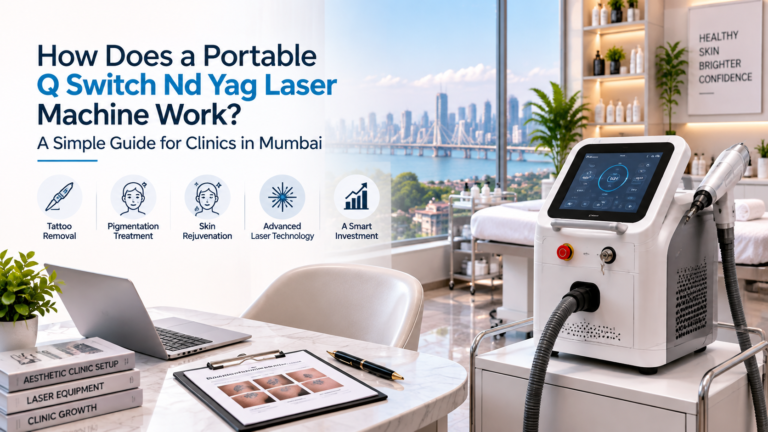
If you’re a dermatologist, cosmetologist or clinic owner in Mumbai researching tattoo removal or pigmentation treatment equipment, you’ve likely come across the term Portable Q Switch Nd Yag Laser Machine. It’s one of the most widely used laser technologies in dermatology and aesthetic clinics across the city, but for many practitioners researching their first laser purchase, the underlying technology can feel technical and hard to pin down.
This guide breaks down how Q-Switched Nd:YAG laser technology actually works, what it’s commonly used for, and what clinics should know before choosing a portable system — explained in plain, practical language rather than manufacturer jargon.
What Is a Q Switch Nd Yag Laser?
Nd:YAG stands for Neodymium-doped Yttrium Aluminum Garnet — the crystal medium used inside the laser to generate its beam. “Q-Switched” refers to the way the laser releases its energy: instead of a continuous beam, a Q-Switched laser stores energy and then releases it in extremely short, high-intensity pulses, typically measured in nanoseconds.
This pulsing mechanism is what makes Q-Switched Nd:YAG lasers particularly suited to treatments like tattoo removal and pigmentation correction. The short, powerful pulses are designed to target pigment particles beneath the skin’s surface with precision, while minimizing prolonged exposure to surrounding tissue.
A portable Q-Switched Nd:YAG laser machine simply refers to a more compact, mobile version of this technology — built into a lighter housing that’s easier to move or fit into smaller treatment rooms, as opposed to larger, cart-mounted vertical systems.
How Does a Portable Q Switch Nd Yag Laser Machine Work?
At a general level, Q-Switched Nd:YAG laser treatment follows a similar process across most systems:
- Energy storage and release: The laser builds up energy internally and releases it in a single, very short, high-intensity pulse rather than a continuous stream.
- Selective targeting: The pulse is designed to be absorbed by specific pigment (such as tattoo ink or melanin) more readily than by surrounding skin tissue, based on the principle of selective photothermolysis — targeting a specific structure using wavelength and pulse duration.
- Fragmentation of pigment: The rapid energy pulse causes targeted pigment particles to fragment into smaller pieces.
- Natural clearance: Over the following weeks, the body’s own lymphatic system gradually clears the fragmented pigment particles, which is why tattoo removal and pigmentation treatments typically require multiple sessions spaced weeks apart rather than a single visit.
Q-Switched Nd:YAG lasers commonly operate using more than one wavelength — most typically a primary wavelength around 1064nm and a secondary wavelength around 532nm — allowing practitioners to target different pigment colors and depths depending on the treatment. Exact wavelength options, pulse settings and specifications vary by manufacturer and model, so these should always be confirmed directly with your equipment supplier rather than assumed to be identical across all machines.
What Is a Portable Q Switch Nd Yag Laser Machine Commonly Used For?
Because of how the technology targets pigment, Q-Switched Nd:YAG lasers are commonly associated with a few core applications:
Tattoo Removal
This is the most widely recognized use. The laser’s pulses are commonly used to break down tattoo ink particles across multiple sessions, with results and the number of sessions required depending on factors like ink color, tattoo age, depth and the individual’s skin.
Pigmentation and Skin Tone Concerns
Beyond tattoos, Q-Switched Nd:YAG technology is also commonly used for addressing certain pigmentation concerns, such as sun spots or areas of uneven skin tone, depending on practitioner assessment.
Skin Rejuvenation Support
Some practitioners use Q-Switched Nd:YAG settings as part of broader skin rejuvenation protocols, where the laser’s effect on the skin’s surface layer is used to support a refreshed appearance over a treatment course. Suitability for this use depends on individual skin assessment.
It’s worth noting that outcomes for all of these applications vary by individual, and a qualified practitioner assessment is essential before any treatment plan is decided — this article is for general educational purposes and isn’t a substitute for professional guidance.
Why Clinics Choose Portable Over Vertical Q-Switch Systems
Clinics evaluating laser equipment generally weigh portable systems against larger, vertical cart-based machines. A few reasons clinics lean toward portable configurations:
- Space efficiency — portable units fit more easily into smaller treatment rooms or clinics with limited floor space
- Flexibility — easier to reposition between rooms, or for practitioners operating across multiple locations
- Lower entry investment — portable systems are often positioned at a more accessible price point compared to full vertical platforms, making them a practical starting point for newer clinics
- Simplicity for lower treatment volumes — well suited to clinics offering tattoo removal or pigmentation treatment as one of several services, rather than a high-volume, dedicated service line
That said, portable systems aren’t automatically the right choice for every clinic — high-volume, dedicated tattoo removal centers may still benefit more from a vertical system’s build and duty cycle. The right choice depends on your clinic’s expected patient volume, space and service mix. Clinics operating across Mumbai and Thane, where treatment room sizes and rental costs vary significantly by area, often factor space efficiency into this decision as much as patient demand.
What to Look for in a Portable Q Switch Nd Yag Laser Machine
Before purchasing, it’s worth evaluating a few practical factors beyond the base technology:
Wavelength Options
Confirm how many wavelengths the machine offers and what treatment applications each is suited for — this affects the range of pigment colors and skin concerns you can treat.
Spot Size and Energy Settings
Adjustable spot size and energy output give practitioners more flexibility across different treatment areas and pigment depths. Ask your supplier for documented specifications rather than general marketing claims.
Cooling and Safety Features
Given the intensity of Q-Switched pulses, proper cooling and built-in safety controls matter for both patient comfort and treatment safety.
Build Quality and Certification
As with any clinical laser equipment, build quality and certification standards affect both safety and long-term reliability — this is worth confirming directly with your supplier.
Training and Technical Support
Proper operator training is essential for any Q-Switched laser system, given the precision required for safe, effective treatment. Confirm what installation and training support is included before purchasing.
Warranty and After-Sales Service
Laser equipment requires long-term servicing and support. Understand your warranty terms and the availability of after-sales support before committing to a purchase.
Portable Q Switch Nd Yag Laser Machine vs Other Tattoo Removal Technologies
Clinics researching tattoo removal equipment often compare Q-Switched Nd:YAG systems against other laser types, such as Pico lasers, which use even shorter picosecond pulses. Both technologies are commonly used for tattoo removal and pigmentation treatment, but they differ in pulse duration and are generally suited to different scenarios depending on ink type, color and depth. Clinics weighing these options can review Total Supply’s Pico Laser / Q-Switch Laser Machine and ND YAG Pico Tattoo Removal Laser Machine pages to compare configurations side by side.
For clinics specifically evaluating Q-Switched systems, Total Supply also offers other Q-Switch Nd:YAG configurations, including the Genelux Q-Switched Nd:YAG Laser Machine, the Ruikd Genelux Lite Q-Switch Laser Machine, and the Active Q-Switch Nd:YAG Tattoo Removal Laser Machine — each suited to different clinic sizes and treatment volumes.
Is a Portable Q Switch Nd Yag Laser Machine a Good Investment for Your Clinic?
Tattoo removal and pigmentation treatment remain consistently requested services across Mumbai’s dermatology and aesthetic clinics, with growing demand from patients in Thane and surrounding areas as well. A portable Q-Switched Nd:YAG laser can be a practical entry point for clinics adding this service, particularly where space or budget is a consideration. Whether it’s the right fit depends on your expected patient volume, treatment scope, and the level of after-sales support behind the machine you choose — factors worth discussing directly with your supplier rather than deciding on price alone.
Clinics in Mumbai and Thane can review the full range of tattoo removal equipment on Total Supply’s Tattoo Removal Machine page to compare portable and vertical configurations by treatment scope and clinic size.
Frequently Asked Questions
How does a Q Switch Nd Yag laser remove tattoos?
The laser delivers short, high-intensity pulses that target tattoo ink pigment, causing it to fragment into smaller particles. The body’s lymphatic system then gradually clears these particles over several weeks, which is why multiple sessions are typically needed.
Is a portable Q Switch laser as effective as a vertical machine?
Effectiveness depends more on the machine’s specific technical specifications, proper calibration and correct treatment protocol than on portability alone. Portable systems are generally suited to lower-to-moderate treatment volumes, while vertical systems are often chosen for high-volume, continuous clinical use.
What wavelengths does a Q Switch Nd Yag laser use?
Q-Switched Nd:YAG lasers commonly operate at a primary wavelength around 1064nm and a secondary wavelength around 532nm, allowing treatment of different pigment colors. Exact wavelength options vary by specific machine and should be confirmed with your supplier.
Can a Q Switch Nd Yag laser be used for anything besides tattoo removal?
Yes, depending on the practitioner’s assessment, Q-Switched Nd:YAG lasers are also commonly used for certain pigmentation concerns and as part of some skin rejuvenation protocols.
How many sessions are needed for tattoo removal with this technology?
The number of sessions varies significantly depending on the tattoo’s ink colors, age, depth and the individual’s skin — a qualified practitioner assessment is needed to estimate a realistic treatment plan.
What should I check before buying a portable Q Switch laser for my clinic?
Beyond price, confirm wavelength options, spot size and energy settings, cooling and safety features, certification, training support, and warranty and after-sales service before making a purchase decision.
Conclusion
A Portable Q Switch Nd Yag Laser Machine works by delivering short, high-intensity pulses that target pigment beneath the skin, making it a widely used technology for tattoo removal and select pigmentation treatments. For clinics in Mumbai and Thane, the appeal of a portable configuration generally comes down to space efficiency, flexibility and a more accessible entry investment compared to vertical systems — though the right choice always depends on your specific patient volume, treatment scope and growth plans. Whichever configuration you choose, prioritizing verified specifications, proper training and reliable after-sales support will matter far more to your long-term results than the machine’s format alone.
Elevate Your Skin Treatments with Advanced Technology
Deliver deeper cleansing, brighter skin, and improved patient satisfaction with professional Carbon Peel and laser-based skin rejuvenation solutions. Partner with Total Supply for high-performance dermatology equipment backed by expert guidance.
Recent Post
-
 23 Oct 2026Hydradermabrasion Machine: Features, Benefits and Uses for Skin Clinics
-
 13 Oct 202612 in 1 Hydrafacial Machine: Features, Functions and Uses for Skin Clinics
-
 08 Oct 2026How Does a Hydrafacial Machine Work? A Complete Guide for Skin Clinics in Mumbai
-
 01 Oct 2026Professional Hydrafacial Machine: Technology, Features & Uses for Modern Skin Clinics
-
 23 Sep 2026How Does a Portable Q Switch Nd Yag Laser Machine Work? A Simple Guide for Clinics in Mumbai
-
 18 Sep 2026How Much Does a Laser Hair Removal Machine Cost in Mumbai? A Clinic Buying Guide